
Learning is feedback loops plus care
An idiosyncratic formulation of what good deliberate learning looks like
Learning effectively is about participating in feedback loops and attuning to care
Most good research on learning has focused on feedback loops and neglected the deeper aspect of care. Feedback loops are the most succinct, powerful way to think about the dynamics of learning, but care is the underlying substrate for discovery and internalization.
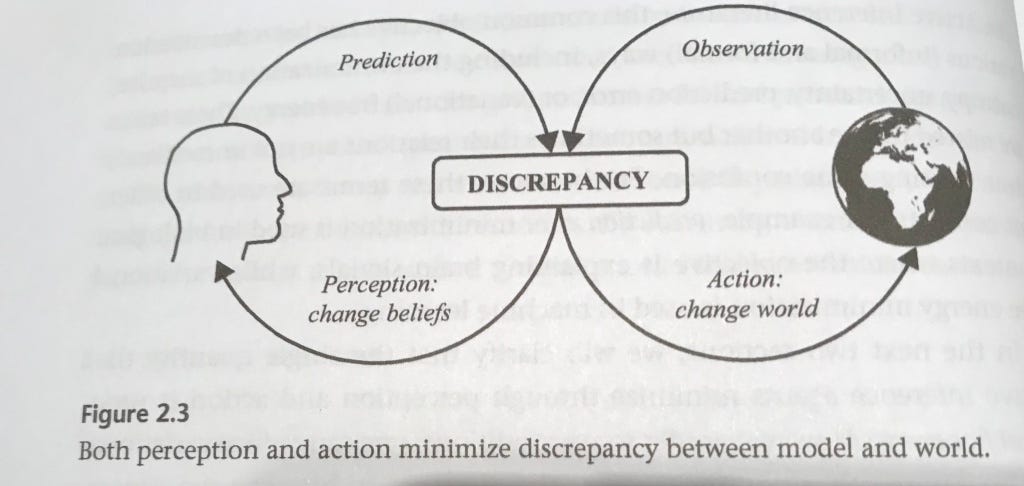
Everything we do can be framed in terms of action and perception. I see the coffee cup (perception) and reach out (action) only to realize it’s not where I expected it (perception) and adjust my hand to grasp the handle (action). We can call this dance of action and perception a feedback loop.
I. On feedback loops
Feedback loops are helpfully framed in terms of signal and noise. High signal feedback is deterministic, immediate, and explicit. Make a spelling error in a word document and the red dotted underline is immediate, consistent, and is unambiguous.
High noise feedback is nondeterministic, delayed, and ambiguous. A parent’s interaction with their upset child is a good example; a child at five may calm down a stuffed dog while a child at fifteen is more likely to feel insulted. Upset, the fifteen year old may not let the parent know for many months — even then, the parent may not have clarity on whether their parenting style could have been better.
Using feedback loops well means trying to create high signal environments that still importantly correspond to the ‘real world’1. Even better is if the feedback can be adversarially chosen to lead to development in the weakest areas — think of the math tutor who sees you struggling with discrete math so gives you some counting problems.
I see all of the interesting results in pedagogy as mostly fitting into ‘improve the feedback loop’:
Ebbinghaus’ forgetting curve is about efficiently distributing feedback over time for deeper learning
Bloom’s finding that one-to-one tutoring outperforms other instructions by two standard deviations is about increasing the rate of feedback over time and also the relevance of the feedback
Vygotsky’s Zone of Proximal Development says that the greatest learning comes from combining i) support of someone more knowledgeable, with ii) learning community, and iii) presenting tasks that people struggle with alone but can solve together.
This is basically about increasing amount and quality of feedback2.
What’s missing is care.
II. Care and why we learn
Care is how we orient to the subject itself. For what reason are you trying to learn? Why do you care about Gödel’s theorem/knitting/The Peloponnesian War? What parts of you are driving the pursuit, and what parts are left out?
When asked why he was interested in numbers in the first place, the mathematical physicist Freeman Dyson responds,
It’s just like asking, “Why does a violinist like to play the violin?” I had this skill with mathematical tools, and I played these tools as well as I could just because it was beautiful, rather in the same way a musician plays the violin, not expecting to change the world but just because he loves the instrument.
The deep answer will not present itself in words. It will be an impulse, perhaps buried; a flash of heat in the stomach at the glimpse of the whole, the slow warmth at the base of the neck, a settling behind the eyes. Deep care has the quality of love — perhaps is none other than love. Wherein the boundary between knower and the known fall away, unveiling the world.
Care is deeply emotional.
Elizabeth Nostrand details a painful version of this realization after spending hundreds of hours rigorously evaluating the claims made in nonfiction books.
I introspected on this, and eventually figured out that at a deep level I felt I needed to believe books, that I was being bad if I disagreed with them. So of course I developed tools to prove my disagreements, which led to the bifurcation- either I was giving in to the original impulse or its counter, without the option of responsiveness…
Though she had an excellent process for coming to understand the claims in the books, it took years to come to face why she cared about this in the first place.
The functional institutions I’ve been in are set up to maximize their assessment criteria, whether that be SAT scores or papers in Nature. Unfortunately, this has had the result of destroying the original care students have had for their subjects3. I think of my many friends who grew up reading, then forced to read in school, no longer able to casually enjoy a book. Or the professors who sadly speaks of the research she would do if only it could be published.
If care is absent, the learner will be ‘going through the motions’. There will be no real vigor or energy behind the work. The world will remain concealed.
What does an environment that fosters care look like? I have glimpsed this in small pockets, fleetingly, so you will have to forgive this impressionism:
Late nights talking, drawing, laughing. A large whiteboard, pieces of paper scattered around. A mess of descriptions, waking up struck with a thought.
Short talks — sharing with passion the love in our mindeyes. Clapping with glee. Obsession with the questions, the feeling of facing something so large you can’t take it all in.
Listening, softly, carefully; the flutter of an answer, the rustle of illumination. Nothing responds but still you listen, trying not to strain, feeling the frustration, giving up then coming back to the stoop with your ears wide open. Your whole being tuned to sound.
Sometimes there is fear, fear of the unknowable, perhaps this is beyond your capacity — leaning into the edge of fear, and the honesty that the edge grants.

One of my favorite examples is Josh Waitzkin buying an eFoil to increase the number of turns he can practice per hour a hundredfold.
To lightly caveat this, I’ll add that Deci and Ryan’s Self-Determination Theory seems helpful in some cases, but missing the core of what it means to care. They claim we have the three psychological needs of autonomy, competence, and relatedness, which are the source of intrinsic motivation. Where is the role of meaning here? I for one have means of these three needs in my piano journey but still struggle with something else. What is that something else?
I’ve written about this in Equations and agency